
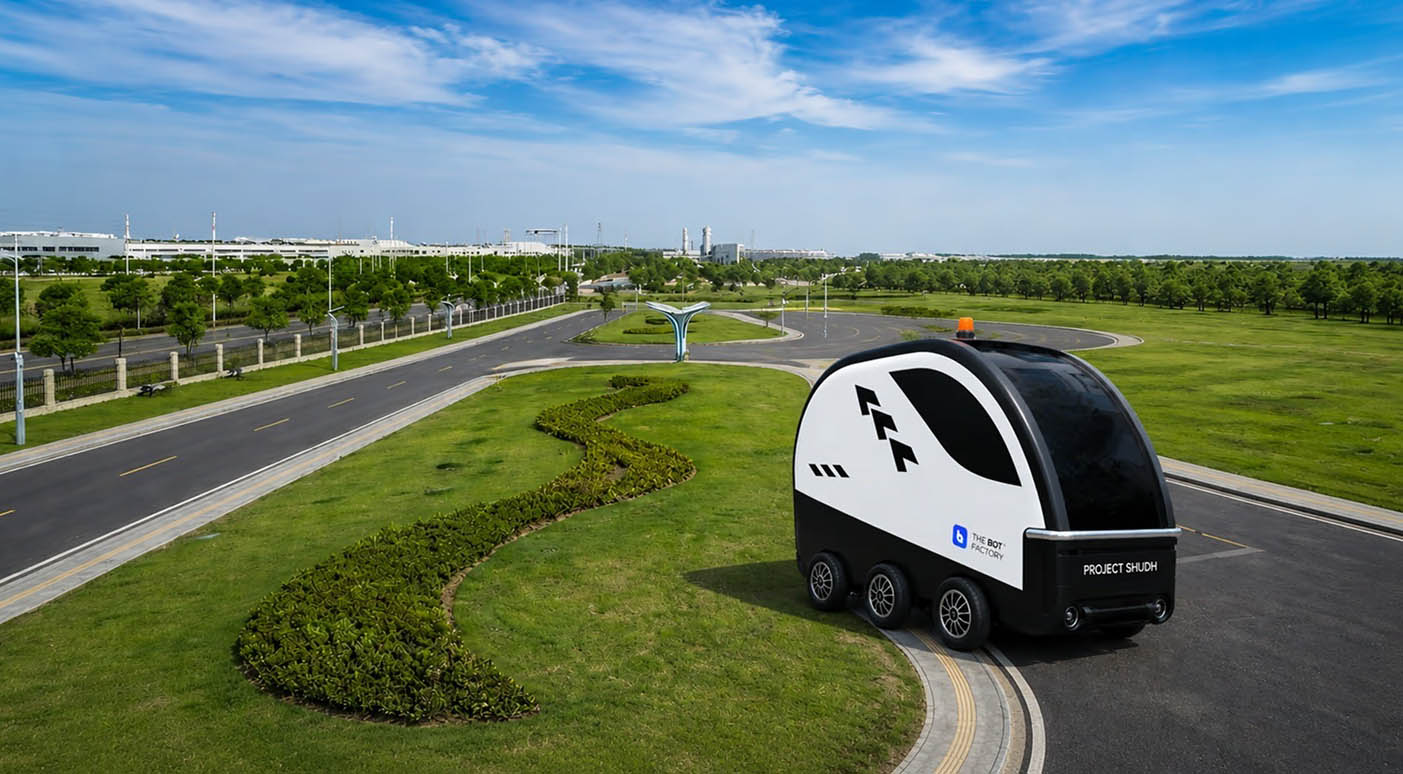
Hyderabad, July 08: In a landmark step towards safer cities, smarter governance and the elimination of hazardous sewer work, Hyderabad-based deep-tech robotics company The Bot Factory will launch Project SHUDH, India’s first AI-powered Sewer Governance Fleet, on July 11, 2026, at T-Works, Hyderabad.
Developed as part of a disaster-management robotics initiative, Project SHUDH represents a significant shift from sewer cleaning to sewer governance.
Sri D. Sridhar Babu, Hon’ble Minister for IT, Electronics, Communications, Industries & Commerce, Government of Telangana, as Chief Guest will formally launch the most coveted solution in the presence Sri Jayesh Ranjan, Special Chief Secretary, Hyderabad Metropolitan Area & Sports, Government of Telangana, as Guest of Honour; and Sri Sanjay Jaju, Chief Secretary, Government of Telangana, as Special Guest.
Unlike most sewer-cleaning technologies that focus solely on mechanization, Project SHUDH is designed as a complete governance platform where every sewer intervention can be digitally tracked, recorded, analysed and monitored. The larger objective is to help cities move towards zero manual sewer entry while enabling smarter management of underground infrastructure.
A Hyderabad Innovation with a National Mission
The Bot Factory is a Hyderabad-based deep-tech robotics company focused on developing intelligent robotic systems for public safety, disaster management, environmental protection and urban infrastructure.
The company has gained attention for Project SHUDH, an AI-powered robotic platform aimed at eliminating the need for human entry into sewers and manholes.
Its mission is to create autonomous robotic systems capable of performing dangerous and hazardous tasks traditionally carried out by humans, thereby improving safety, efficiency and accountability.
From Sewer Cleaning to Sewer Governance
While conventional technologies largely focus on mechanized cleaning, Project SHUDH introduces a comprehensive governance framework for underground assets.
The platform combines: Autonomous sewer-cleaning robots, Artificial Intelligence (AI), GIS and satellite-based monitoring, Predictive analytics for blockage detection and Real-time governance dashboards for civic authorities
The objective is not merely sewer cleaning but the creation of a digital, auditable and data-driven management system for underground infrastructure.
Every intervention generates actionable data, transforming underground maintenance from a reactive activity into a transparent and accountable governance process.
A Technological Solution to a Human Challenge
Despite advances in mechanization, sewer workers across India continue to face significant occupational risks.
Project SHUDH seeks to eliminate the need for human entry into hazardous sewer environments by deploying intelligent robotic systems capable of cleaning, inspection and data collection.
The initiative aligns closely with national priorities relating to worker safety, Smart Cities, digital governance and technology-led public service delivery.
Proven in the Field
Project SHUDH has already been demonstrated in Hyderabad in collaboration with the Hyderabad Metropolitan Water Supply & Sewerage Board (HMWS&SB).
The system is capable of operating in both vertical manholes and horizontal sewer pipelines while generating real-time operational data and digital maps of underground drainage networks.
These capabilities enable authorities to monitor infrastructure health, identify recurring problem areas and make informed maintenance decisions.
What sets Project SHUDH apart is its vision of creating an intelligence layer beneath cities. By combining robotics, AI, predictive analytics and geospatial technologies, the platform transforms underground infrastructure into a measurable, monitorable and governable public asset.
The long-term goal is to help cities achieve zero manual sewer entry, improve worker safety, reduce operational costs and establish a modern governance framework for underground infrastructure.
Addressing a National Challenge
India’s sewer and septic infrastructure remain significantly under-mechanized and under-digitized. In most cities, sewer maintenance is carried out through a combination of jetting machines, suction equipment, desilting vehicles and manual intervention. When mechanical methods fail to resolve blockages, workers are often required to enter manholes and sewer networks, exposing them to hazardous and potentially life-threatening conditions.
This underlines the urgent need for technology-driven solutions such as robotic and AI-powered sewer management systems.
India has an estimated 800,000 sanitation and sewer-cleaning workers involved in sewer, septic tank and drain maintenance activities.
Thousands continue to be engaged in hazardous cleaning work despite legal prohibitions.
According to data presented in Parliament, 377 deaths due to hazardous cleaning of sewers and septic tanks were reported between 2019 and 2023.
Enormous Market Potential
The potential market for Project SHUDH is substantial. India has: More than 4,500 statutory towns, Hundreds of municipal corporations and municipalities, Smart Cities, Water and sewerage boards, Industrial townships and Cantonment boards
The domestic requirement could eventually run into thousands of robotic units. If every manhole inspection, blockage, cleaning operation and repair is digitally recorded, municipalities gain: Greater accountability, Complete audit trails, Performance monitoring, Contractor oversight, Predictive maintenance capabilities, Improved budget planning
India’s underground infrastructure remains one of the least digitized public assets. If Project SHUDH succeeds in integrating robotics, AI and governance into a unified platform, it could create an entirely new category of urban technology serving thousands of municipalities and utility agencies across the country.