
New Delhi: India’s sporting landscape is undergoing a fundamental shift as sport increasingly emerges as a major commercial and investment opportunity. Beyond packed stadiums and television audiences, the sector is generating activity across media rights, sponsorships, technology, infrastructure, sports equipment, merchandising and athlete endorsements.
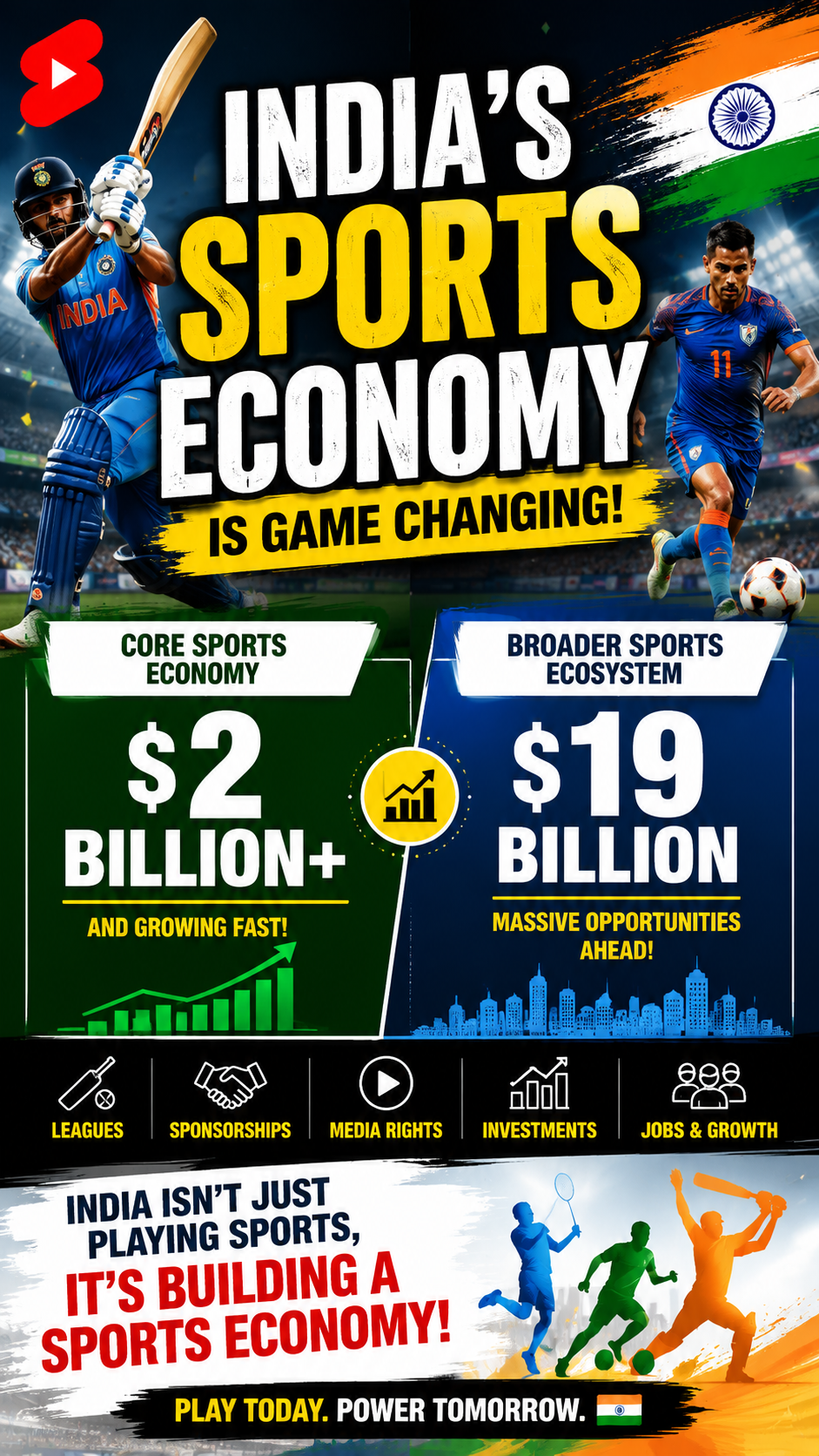
The country’s core commercial sports economy crossed the $2 billion mark in 2025, reaching approximately ₹18,864 crore, according to WPP Media’s Sporting Nation 2025 report. The figure represents a 13.4 per cent increase from ₹16,633 crore in 2024, highlighting the accelerating flow of advertising and commercial spending into sporting properties.
However, the opportunity becomes considerably larger when the wider ecosystem is taken into account. KPMG estimates India’s broader sports industry at around $19 billion in FY2024-25 and projects that it could exceed $40 billion by 2030, supported by increasing investments, digital consumption, infrastructure development and the professionalisation of multiple sports.
Cricket Still Drives the Commercial Engine
Cricket remains the undisputed heavyweight of India’s sports economy. According to WPP Media, cricket contributed nearly 89 per cent of the core sports economy in 2025, underlining the extraordinary commercial influence of the sport.
The Indian Premier League (IPL) sits at the centre of this ecosystem. Its franchise structure, broadcast and digital rights, sponsorships, advertising, ticketing and merchandise have transformed cricket into a sophisticated entertainment and business platform. KPMG estimated the IPL’s value at approximately $18 billion in FY2025.
The success of the IPL has also created a blueprint for professionalisation that other sports are attempting to follow.
Digital Consumption Changes the Business Model
The sports audience is increasingly moving across television, streaming platforms and social media, creating new monetisation opportunities for rights holders and advertisers.
WPP Media estimates that media accounted for 51 per cent of India’s core sports economy in 2025. Digital advertising associated with sports rose significantly during the year, reflecting the growing importance of streaming and online engagement.
For sports properties, this means the commercial opportunity no longer ends when a match is over. Short-form videos, live digital coverage, social media content, fan communities and data-driven engagement are becoming important parts of the revenue ecosystem.
Sponsorship Becomes a Bigger Growth Driver
Brands are also increasing their presence around sporting properties. Sports sponsorship spending reached an estimated ₹7,943 crore in 2025, accounting for roughly 42 per cent of the core sports economy, according to WPP Media.
Cricket continues to command the largest share of sponsorship budgets, but advertisers are increasingly looking beyond the traditional cricket audience. Football, kabaddi, badminton, athletics and other sports are creating additional platforms for companies seeking targeted engagement with younger and more diverse audiences.
The growing visibility of women’s sports is another potential catalyst for sponsorship growth.
Sports Technology Opens a New Business Frontier
Technology is becoming one of the fastest-evolving components of the sports ecosystem.
Artificial intelligence, performance analytics, wearable devices, digital ticketing, streaming technology and fan-engagement platforms are changing the way athletes train and audiences consume sport.
KPMG estimates India’s sports-tech sector at approximately $1.6 billion, indicating that the country’s sports opportunity extends well beyond traditional leagues and broadcasters.
For entrepreneurs, this creates potential across athlete performance, fan engagement, sports data, ticketing, content creation, training platforms and digital commerce.
Infrastructure and Sports Manufacturing Add Scale
The economic impact of sport also reaches industries that operate behind the scenes.
India’s expanding sports infrastructure requires stadiums, training centres, academies, community facilities and specialised sporting venues. KPMG estimates sports infrastructure investment at around $2.7 billion, with the potential to reach approximately $6 billion by 2030.
Sports-goods manufacturing represents another significant opportunity. The sector is estimated at about $6.7 billion and could grow to around $11 billion by 2030, according to KPMG.
This creates opportunities for domestic manufacturers while also strengthening India’s position in the global sports supply chain.
The Next Opportunity Lies Beyond Cricket
India’s biggest challenge could also become its biggest opportunity: reducing the commercial concentration around cricket.
Professional leagues have helped sports such as kabaddi and football establish stronger commercial identities, while badminton, athletics, hockey, chess, volleyball and women’s competitions are gaining visibility.
A broader sporting economy could distribute investment more widely, creating additional opportunities for athletes, coaches, broadcasters, sponsors, technology companies and local businesses.
The development of regional sporting ecosystems could be particularly important. Smaller cities and towns can become centres for academies, competitions, sports tourism and equipment manufacturing if investment and infrastructure keep pace with growing participation.
Athletes Are Becoming Brands
The economics of Indian sport is also changing at the individual level. Successful athletes are increasingly building personal brands that extend beyond their performances.
Endorsements, social-media partnerships, appearances and content collaborations are creating additional income streams for athletes. WPP Media estimates India’s sports celebrity endorsement market reached approximately ₹1,350 crore in 2025, with cricket continuing to dominate but opportunities emerging for athletes from other disciplines.
Social platforms have further reduced the distance between athletes and fans, allowing sports personalities to build audiences independently of broadcasters and league organisers.
What Will Drive the Next Five Years?
The next phase of India’s sports economy is likely to be shaped by several interconnected trends:
- Greater digital and streaming consumption
- Expansion of professional leagues
- Rising investment in women’s sports
- Growth of sports technology and AI
- New sports infrastructure
- Expansion of sports-goods manufacturing
- Increasing athlete endorsements
- Growth in sports merchandise and e-commerce
- Development of sports tourism
- Greater grassroots participation
Together, these trends could transform sport into a broader economic platform rather than an industry primarily dependent on match-day revenue and broadcasting.
A Market Bigger Than the Scoreboard
India’s sports story is increasingly becoming an economic story.
The $2.13 billion core commercial sports economy demonstrates the current scale of advertising, sponsorship and media-related activity, while the broader $19 billion sports ecosystem captures a much larger universe of infrastructure, technology, manufacturing and related businesses.
If current growth continues, the prospect of a $40 billion-plus sports industry by 2030 could put India among the world’s most important emerging sports markets.
For India, the opportunity is no longer simply about producing more sporting champions. It is about building the ecosystem around them — from the playing field and training academy to the streaming platform, sports-tech startup, manufacturing facility and global brand.
The next big Indian sporting success story may not be measured only in medals. It could be measured in jobs, investments, businesses and billions of dollars created around the game.