
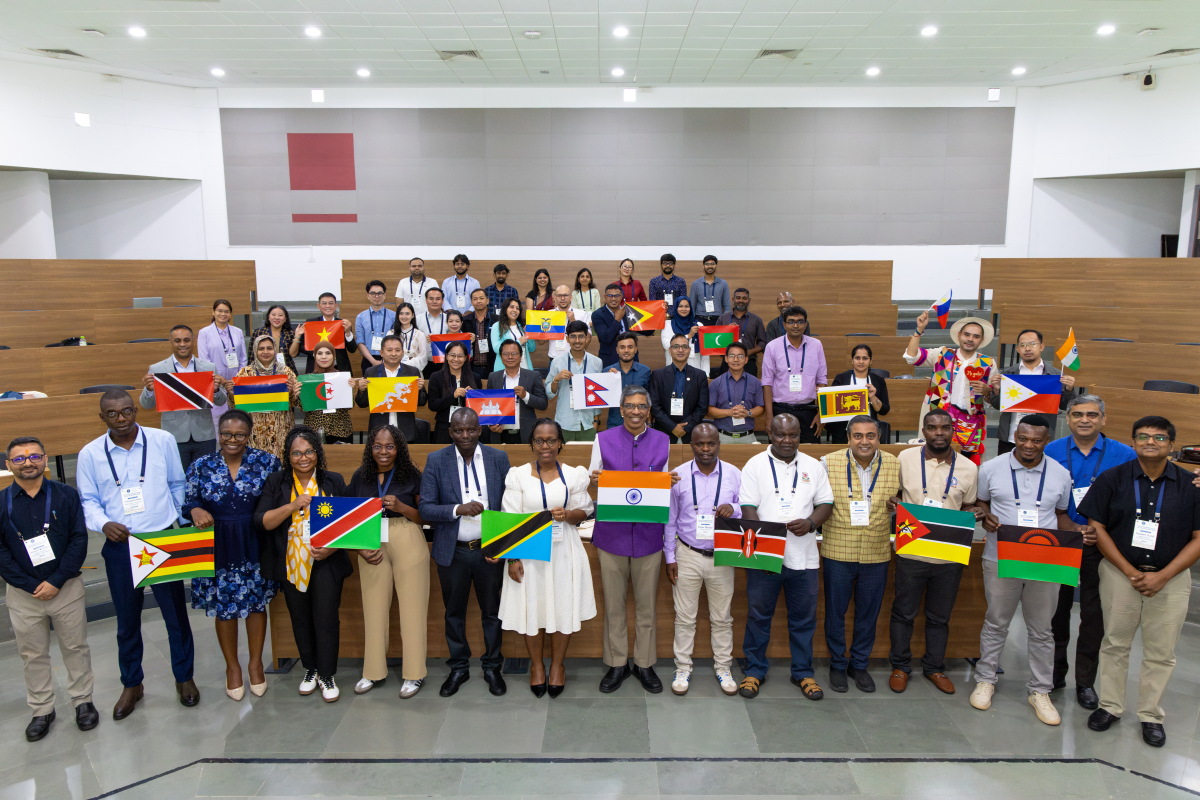
Gandhinagar | Sept 15: IIT Gandhinagar is hosting a two-week Faculty Development Program for ASEAN and Global South under the Indian Technical and Economic Cooperation (ITEC) program of the Ministry of External Affairs, with faculty members from 20 countries participating in the program from September 14 to 25.
The participants are from Algeria, Bhutan, Cambodia, Ecuador, Egypt, Kenya, Laos, Malawi, Maldives, Mauritius, Mozambique, Namibia, Nepal, the Philippines, Sri Lanka, Tanzania, Timor-Leste, Trinidad and Tobago, Vietnam and Zimbabwe. The program brings together faculty members from different higher education systems for sessions on teaching and pedagogy, research, innovation, international collaboration and institutional practices.
The ITEC Faculty Development Program covers contemporary approaches in higher education, including active learning, learner-centric teaching, curriculum innovation, international academic collaboration, research, innovation and incubation, institutional development and student well-being.
Speaking at the inaugural session, Prof Rajat Moona, Director, IIT Gandhinagar, spoke about the importance of international academic engagement. He said the program provides a platform for academic learning, cultural exchange and building connections across countries.
Encouraging the participants to make the most of their time at IIT Gandhinagar, he said, “There are quite a lot of new things to learn in this program. I hope this helps us develop interesting partnerships and build relationships that help us grow as institutions.”
Prof Moona also spoke about IIT Gandhinagar’s efforts towards internationalisation and encouraged the participants to experience the academic and cultural diversity of Gujarat and India during their stay.
During the inaugural session, Prof Amit Prashant, Dean of External Relations, IIT Gandhinagar, stressed the importance of bringing faculty members from different countries together to exchange their experiences and perspectives on higher education. He said such interactions can help participants understand different academic practices and explore opportunities for future collaboration.
He spoke about the changing role of faculty in a technology-driven world and the need to rethink educational programs to prepare students for evolving professional environments. He stressed that higher education must focus not only on technical skills but also on building competencies and confidence among students. His remarks were in line with the program’s session on ‘Role of Faculty in Future of Education’, which looks at how faculty roles and educational approaches need to evolve in response to changing technologies and the needs of learners and industry.
“For me, it has brought new insights that I can take back and adapt in my home institution, while also opening avenues for international cooperation in teaching and learning,” said Dr Frank Mwamakula, Senior Lecturer, School of Education, St Augustine University, Tanzania.
Phan Thanh Huyen, University of Social Sciences and Humanities, Vietnam National University, Ho Chi Minh City, said, “We can learn from each other and avoid difficulties or problems that others have already faced. We can speak about our successes and learn from the experiences of others. When we collaborate with other countries, we can learn from their experiences and share the ideas and problems that we have faced.”
Joel Mark Baysa Barredo, Miriam College, Philippines, said, “This Faculty Development Program allows you to breathe and understand others’ experiences and their journey within academia. At the same time, you collaborate on academic or personal activities that could help you grow and bring back that enthusiasm. Knowing that there are other human beings doing the same thing in the Global South reminds you that there is value in teaching and in shaping the minds of people.”
The academic sessions during the program cover a range of themes relevant to faculty members and higher education institutions. These include ‘Role of Faculty in Future of Education’, ‘Active Learning in STEM Education’, ‘Learner-Centric Approaches for Online and Onsite Classrooms’ and ‘Innovations in Pedagogy and Curriculum’, to name a few.
Research and innovation are also part of the program. Participants will be introduced to the Institute’s research ecosystem, support systems and achievements, followed by interactions with research clusters and centres and tours of research facilities.
The program also includes sessions on innovation and entrepreneurship, covering the innovation and incubation ecosystem at IIT Gandhinagar Research Park, interactions with startups incubated at the Research Park, and a panel discussion on ‘Faculty and Startups: Building an Innovation-Driven Startup Ecosystem’.
Other sessions will cover institutional administration and governance, alumni engagement, faculty development and support systems, student research mentorship and student well-being.
The program also includes study tours and visits to sites in Gujarat, including the Statue of Unity, Sabarmati Ashram, Rani Ki Vav, Modhera Sun Temple and Gujarat International Finance Tec-City (GIFT City).
The program will conclude on September 25 with participant feedback and a valedictory function.
The inaugural session was moderated by Prof Ashutosh Srivastava, Co-Coordinator, who provided an overview of the program. Prof Amit Prashant, Dean of External Relations, delivered the welcome remarks, followed by an address by Prof Rajat Moona, Director, IIT Gandhinagar. The session concluded with a vote of thanks by Co-Coordinator of the program, Prof Sameer Patel.