Nov 16: We are bringing you news and highlights from Gartner IT Symposium/Xpo, taking place this week in Kochi, India. Below is a collection of the key announcements and insights coming out of the conference.
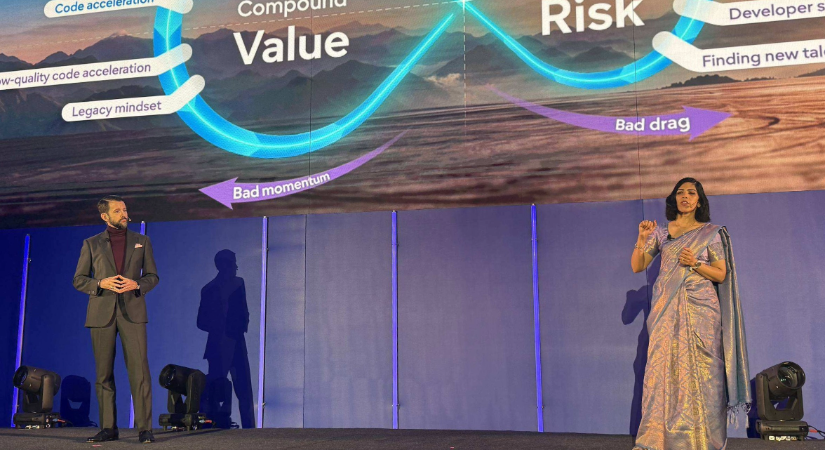
On Day 1 from the conference, we are highlighting the Gartner opening keynote presentation, the top strategic trends in software engineering for 2026 and beyond, and the imperative and impact of Sovereign AI for India.
Gartner Opening Keynote: Reaching Escape Velocity - Shaping an Effective Enterprise AI Economy
Presented by Nate Suda, VP Analyst, Gartner and Neha Kumar, Senior Director Analyst, Gartner
As AI becomes embedded across the enterprise, value is increasing, but risk is growing at a much faster rate. In the Opening Keynote,Nate Suda, VP Analyst at Gartner andNeha Kumar, Senior Director Analyst at Gartner, explained how CIOs and IT leaders can build an approach to drive good AI momentum while balancing value against compounding risk.
Key Takeaways
- “AI is building value quickly, but risk is growing even faster. To build compounding value, CIOs must govern the risk.”
- “The new CIO imperative is to align value with risk and align safety with governance. Without this alignment, AI will create risk faster than organizations can create value.”
- “Value and risk can’t be managed separately. They are interconnected outcomes that compound as AI adoption accelerates.”
- “Momentum accelerates outcomes, while drag slows outcomes. CIOs who outperform know how to create positive momentum and strategically introduce good drag, while reducing bad momentum and bad drag.”
- “The goal is not simply to move faster. It is to build momentum and apply the right drag so you can build more value safely.”
Top Strategic Trends in Software Engineering for 2026 HY2
Presented by Manjunath Bhat, Distinguished VP Analyst, Gartner
Thriving amid heightened economic and social volatility requires organizations to empower their software engineering teams with new approaches to improving productivity, efficiency and effectiveness. In this session,Manjunath Bhat, Distinguished VP Analyst at Gartner, unveiled Gartner’s latest software engineering trends to watch, and discussed the critical shifts shaping the future of software engineering through 2026 and beyond.
Key Takeaways
- “Gartner’s top software engineering trends are grouped into two core themes: AI in the software development life cycle (SDLC), which focuses on adopting AI-native development practices, and SDLC for AI, which focuses on building AI applications and agents.”
- “AI-native development platforms improve developer productivity and reduce costs for CIOs. While productivity is the immediate opportunity, the greatest benefits will be realized through creativity and domain expertise.”
- “The instinct is to chase the best model. However, coding harnesses play a greater role in determining AI-generated output quality than model selection.”
- “By 2030, 70% of enterprises will sandbox agentic development workflows in preproduction environments, up from 10% in 2026. Sandboxes enforce least-privilege permissions at all layers of the runtime infrastructure stack providing agents with bounded autonomy.”
- “Local AI should not be viewed as a replacement for frontier model APIs, but as a strategic routing decision that aligns AI inference with business, security and operational requirements.”
Sovereign AI for India: The Imperative and Its Impact
Presented by Shubhangi Vashisth, Senior Director Analyst, Gartner
As India advances its AI ambitions, sovereign AI is becoming a strategic imperative that extends beyond technology to encompass digital autonomy, innovation, governance and economic competitiveness. In this session,Shubhangi Vashisth, Senior Director Analyst at Gartner, discussed why sovereign AI matters for India and how governments, technology providers and enterprises can navigate the opportunities and challenges of developing AI ecosystems that are secure, trusted and tailored to local needs.
As India advances its AI ambitions, sovereign AI is becoming a strategic imperative that extends beyond technology to encompass digital autonomy, innovation, governance and economic competitiveness. In this session,Shubhangi Vashisth, Senior Director Analyst at Gartner, discussed why sovereign AI matters for India and how governments, technology providers and enterprises can navigate the opportunities and challenges of developing AI ecosystems that are secure, trusted and tailored to local needs.
Key Takeaways
1.“Sovereign AI reflects a nation’s ambition to accelerate AI capabilities and achieve sovereign objectives without foreign assistance, necessitating sovereign investment in domestic innovation and enterprise investment in regional tools.”
2.“Enterprises should embrace sovereign AI imperatives by shifting AI gravity from global standards to regional autonomy, strengthening resilience and investment to deliver robust, locally tailored capabilities.”
3. “Sovereignty requires evidence across three dimensions: data sovereignty, operational sovereignty and technological sovereignty.”
4.“By 2029, 75% of nation-states’ sovereign AI will have overpromoted localization, resulting in costly course correction to regain global AI influence.”
That’s a wrap on Day 1! You can view the completeagenda for the rest of the conferencehere. If any session interests you and you would like to get more insights, you can reach out to us, and we can set up an interaction with the analyst.