Sair-e- Motorcar brings together Kathak and vintage automobiles in a compelling cultural narrative led by Dr Navina Jafa and commissioned by Diljeet Titus
There are objects that belong to history, and then there are those that carry history within them. Vintage cars belong firmly to the latter. They do not merely exist as machines but as symbols of power, personality, and presence. In Sair e Motorcar, these silent icons are reimagined through the language of Kathak, in a production that is as intellectually layered as it is visually evocative.
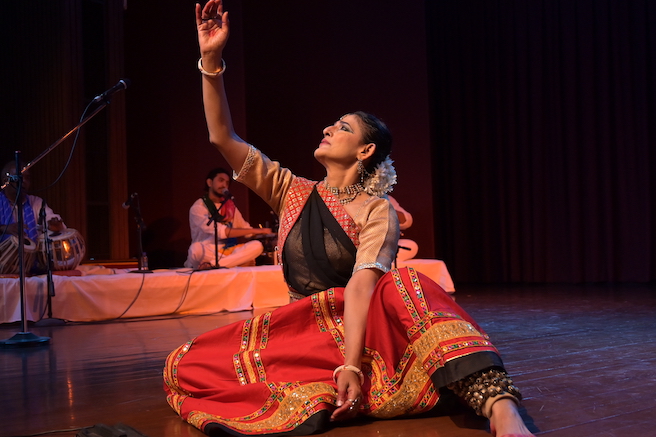
Commissioned by noted collector Diljeet Titus and conceptualised, written, and performed by Kathak exponent and cultural historian Dr Navina Jafa, the production finds its direction under Maya Kulkarni. Together, they create a work that moves beyond performance into the realm of cultural interpretation.
“Vintage cars have always felt like personalities rather than possessions,” says Diljeet Titus. “Each one carries a story, a temperament, and a certain old world grace. With Sair e Motorcar, the idea was to bring that alive, to move away from static display and allow these machines to be experienced through movement, music, and narrative.”
At the centre of this vision is Dr Navina Jafa, whose performance anchors the work with remarkable clarity and depth. Appearing first in a powder blue costume that recalls the languid elegance of princely India, she establishes the tone of the evening. Her footwork carries the precision of a finely tuned engine, while her chakkars move with the assurance of a vintage chassis in motion. Rather than imitating cars, she inhabits their rhythm and presence.
“For me, the cars are not literal references,” says Dr Navina Jafa. “They are metaphors for a way of being. Kathak allows me to explore that through rhythm, through stillness, and through the idea of movement that is both controlled and expansive. It is about translating presence into the body.”
Threading the performance together is the character of Firdausi Mirza, portrayed by Sudheer Rikhari, who brings wit and narrative ease to the production. Through his storytelling, the audience is drawn into a world of eccentric collectors, princely indulgences, and the quiet drama of machines that once defined status and style.
As the work unfolds, the tonal register deepens. One of the most striking moments comes in the courtesan bathing sequence, performed with the dancer’s back to the audience. It is a study in restraint and suggestion, where gesture replaces spectacle and abhinaya finds a deeply internal expression.
The musical composition adds further richness to the experience. The rhythmic precision of Guru Fateh Singh Gangani finds a natural dialogue with Jafa’s footwork, while Fateh Ali brings melodic refinement. Vocals by Shuheb Hasan and Manal Ahmed Khan create an atmosphere that is immersive and textured.
The production also extends its engagement with heritage into its process. Students from Jamia Millia Islamia contributed to stagecraft and digital outreach, bringing a contemporary lens to a classical form. A handcrafted costume by Kalbelia artist Sua Sapera adds another layer of cultural dialogue, bridging folk traditions with classical performance.
What emerges from Sair e Motorcar is a work that treats both dance and automobiles as cultural texts. It reflects on memory, movement, and the aesthetics of presence with a rare sensitivity.
In doing so, Dr Navina Jafa elevates Kathak into a space where it engages with industrial heritage without losing its classical integrity. The result is a production that feels both rooted and contemporary, offering audiences an experience that is at once reflective and visually compelling.
