
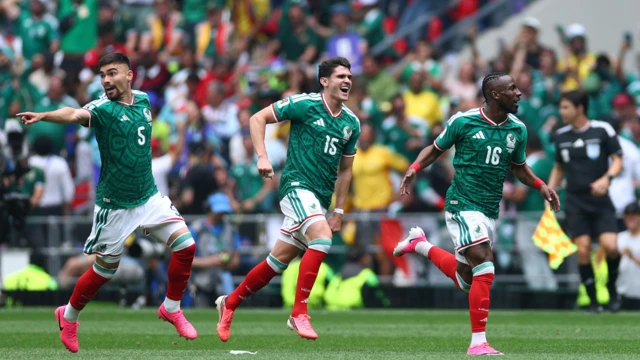
The FIFA World Cup 2026 could hardly have scripted a more dramatic opening night.
History was made. Records were matched. Tempers flared. Three red cards were shown. More than 80,000 supporters transformed the iconic Estadio Azteca into a cauldron of noise. And by the time the final whistle echoed across Mexico City, the host nation had delivered a powerful statement to the footballing world.
Mexico‘s 2–0 victory over South Africa was far more than an opening-match win. It was a showcase of discipline, tactical maturity, home advantage, and the emotional intensity that only a FIFA World Cup can produce.
For Mexico, it was the perfect start to the first-ever 48-team World Cup.
For South Africa, it was a harsh lesson in how quickly a match can unravel when discipline disappears.
The First Goal of a New World Cup Era
Every World Cup produces a moment that enters football folklore forever.
For FIFA World Cup 2026, that moment arrived in the ninth minute.
Mexico‘s relentless pressing forced a costly mistake as South Africa attempted to build from the back. Érik Lira reacted instantly, threading a perfectly weighted pass to Julián Quiñones, who calmly slotted beyond goalkeeper Ronwen Williams.
The stadium erupted.
The goal not only gave Mexico the lead but also ensured Quiñones would forever be remembered as the scorer of the first goal of the FIFA World Cup 2026.
Playing in front of a sea of green shirts, Mexico looked comfortable and confident. Their midfield dictated possession, their pressing suffocated South Africa‘s build-up play, and their attacking transitions repeatedly exposed weaknesses in the opposition defense.
Quiñones nearly doubled the advantage before halftime when his low strike crashed against the post in the 42nd minute, while South Africa‘s only meaningful first-half effort came through Mbekezeli Mbokazi, whose long-range attempt was comfortably gathered by Raúl Rangel.
Despite trailing by a single goal, South Africa remained within touching distance.
That hope would not last long.
The Red Card That Changed Everything
If the first half belonged to Mexico tactically, the second half was defined by a single moment of indiscipline.
Five minutes after the restart, South African midfielder Yaya Sithole brought down Brian Gutiérrez during a dangerous attacking transition.
Referee Wilton Sampaio immediately produced a red card.
The decision changed the match.
Reduced to ten men, South Africa lost their midfield structure and defensive balance. Mexico sensed vulnerability and immediately increased the tempo, stretching the field and exploiting the additional space available between the lines.
What had been a competitive contest quickly became a battle for survival.
The dismissal effectively ended any realistic hopes of a South African comeback.
Raúl Jiménez Writes His Name into History
Mexico‘s growing dominance was eventually rewarded in the 66th minute.
Roberto Alvarado delivered a magnificent in-swinging cross from the right flank, and veteran striker Raúl Jiménez timed his run perfectly. Rising above the defense, he planted a powerful header into the back of the net.
The goal carried significance beyond the scoreline.
It marked Jiménez’s 46th international goal for Mexico, drawing him level with legendary striker Jared Borgetti as the second-highest goalscorer in the history of the Mexican national team.
More remarkably, it was his first-ever FIFA World Cup goal despite appearing in four different World Cup tournaments.
The celebration reflected years of perseverance, resilience, and redemption.
At 2–0, the result felt secure.
The drama, however, was only beginning.
The Late Meltdown
As the clock ticked down, frustration began to overshadow football.
South Africa‘s discipline completely collapsed in the closing stages.
Substitute Themba Zwane became the second South African player dismissed after a VAR review identified violent conduct during an off-the-ball altercation. The dismissal reduced South Africa to nine men and effectively ended any remaining resistance.
Yet one final twist remained.
Deep into stoppage time, Mexico captain César Montes produced an unnecessary challenge on Khuliso Mudau to halt a counterattack. Referee Sampaio wasted no time producing a straight red card.
The final whistle confirmed a remarkable statistic.
Three red cards.
No previous FIFA World Cup opening match had produced such a dramatic disciplinary tally.
The opening game of World Cup 2026 had set an entirely new benchmark for controversy.
Referees Send an Early Tournament Warning
One of the biggest talking points from the evening was the performance of the officiating team.
Brazilian referee Wilton Sampaio, assisted by compatriots Bruno Pires and Bruno Boschilia, demonstrated an uncompromising commitment to enforcing FIFA‘s disciplinary regulations.
Violent conduct.
Tactical fouls.
Denial of goalscoring opportunities.
None were tolerated.
The message to the remaining nations was crystal clear.
This World Cup will reward discipline and punish recklessness.
Teams that lose emotional control may find their tournament hopes disappearing as quickly as South Africa‘s did inside Estadio Azteca.
Mexico‘s New Generation Announces Itself
While the red cards dominated headlines, Mexico‘s football deserved equal recognition.
Julián Quiñones was a constant attacking menace and scored the historic opening goal.
Érik Lira controlled midfield brilliantly, registered an assist, and later declared that “the sky is the limit” for Mexico‘s ambitions.
Roberto Alvarado consistently stretched South Africa‘s defense and delivered the cross that produced Jiménez’s landmark goal.
Meanwhile, Raúl Jiménez reminded the football world that experience remains invaluable in tournament football.
Together, they showcased a Mexican side capable of blending youthful energy with veteran composure.
The Azteca Advantage Remains Real
If there was one lesson beyond the football itself, it was this:
Playing Mexico at Estadio Azteca remains one of international football’s toughest assignments.
The combination of altitude, relentless crowd noise, and emotional pressure visibly wore South Africa down as the match progressed.
By the final thirty minutes, the visitors looked physically exhausted and mentally overwhelmed.
The iconic venue once again proved why it remains one of football’s greatest fortresses.
As the first stadium in history to host matches across three FIFA World Cups, Estadio Azteca delivered a fitting stage for the beginning of football’s newest era.
Key Takeaways
1. Mexico Mean Business
The hosts secured a memorable opening victory and immediately established themselves as one of the tournament’s most dangerous dark horses.
2. Discipline Could Define World Cup 2026
Three red cards in the very first match sent an unmistakable warning to every team in the competition.
3. South Africa Face an Uphill Battle
With crucial matches against South Korea and Czechia still to come, Hugo Broos’ side must improve both tactically and emotionally.
4. The New Era Has Arrived
The first-ever 48-team FIFA World Cup began with goals, history, controversy, and unforgettable drama—everything football fans hoped for and more.
Match Information
Competition: FIFA World Cup 2026 – Group A
Venue: Estadio Azteca, Mexico City
Result: Mexico 2–0 South Africa
Goals: Julián Quiñones (9′), Raúl Jiménez (66′)
Red Cards: Yaya Sithole (50′), Themba Zwane (83′), César Montes (90+2‘)
Referee: Wilton Sampaio (Brazil)
Attendance: 80,000+ spectators
Recommended Thumbnail
Headline
WORLD CUP 2026 OPENER ERUPTS!
3 RED CARDS • JIMÉNEZ MAKES HISTORY
MEXICO 2–0 SOUTH AFRICA
Visual Layout
– Left: Raúl Jiménez celebrating after scoring.
– Center: FIFA World Cup Trophy with Estadio Azteca illuminated in the background.
– Right: Referee Wilton Sampaio holding a red card while South African players react.
– Bottom Score Strip: Mexico 2–0 South Africa.
– Background Elements: Mexican supporters waving flags, stadium floodlights, and subtle World Cup branding.
Final Word
The FIFA World Cup 2026 opener delivered precisely what global football craves—history, emotion, controversy, milestones, and unforgettable drama.
More importantly, it delivered a message.
Mexico are not merely hosting this World Cup.
Under the lights of Estadio Azteca, they announced themselves as genuine contenders.
And if the opening night is any indication, the road to lifting football’s most coveted trophy promises to be extraordinary.